Cyber security threats businesses must prepare for in 2026

Most business owners do not think about cyber security until something goes wrong. A staff member clicks a link that looks ordinary. An invoice is paid into a bank account that belongs to someone else. A file server locks up on a Monday morning and nobody can open a document.
Attackers no longer choose targets by size. They choose by opportunity, and smaller organisations often present the easiest one. Automated tools scan the internet constantly for an unpatched system, a reused password or an employee having a busy day.
Understanding the cyber security threats 2026 has brought with it is not about becoming a technical expert. It is about knowing where the pressure is coming from and which steps genuinely reduce risk.
Key takeaways
- Ransomware featured in 48 per cent of breaches analysed in the Verizon 2026 Data Breach Investigations Report, up from 44 per cent.
- Phishing attacks on businesses are still the most reported cybercrime, and generative AI has removed the obvious warning signs.
- Credential and session theft lets attackers log in as a real user, so multi-factor authentication alone is no longer enough.
- Unpatched software has overtaken stolen passwords as the most common initial access route, and remote work has widened the attack surface further.
- Ransomware protection for business depends on isolated, tested backups, not on paying a ransom.
Why the threat landscape has changed
Criminal groups now operate commercially, selling ready-made attack kits to anyone willing to pay, and generative AI has removed the traditional clues: poor grammar and fake logos no longer give an attacker away. IBM’s Cost of a Data Breach Report found AI-driven attacks rising sharply year on year, with the global average cost of a breach reaching a record USD 4.99 million in 2026. Cloud applications, mobile devices, remote access tools and suppliers each add another connection that must be secured.
Phishing attacks on businesses are getting harder to spot
Phishing is still the most common way an attack begins. The FBI’s Internet Crime Complaint Center recorded 191,561 phishing and spoofing complaints in its latest annual report, the most reported cybercrime category for a third consecutive year.
The heaviest damage comes from a related tactic: business email compromise. An attacker monitors email traffic, waits for a genuine invoice discussion, then steps in with new bank details. That tactic alone accounted for more than USD 3 billion in reported losses from fewer than 25,000 complaints.
Phishing has also moved beyond email into SMS, messaging apps and voice calls, with mobile-delivered tests attracting around 40 per cent higher engagement than email. The defences are unglamorous but effective: verify payment changes by phone using a number you already hold, and require a second approver above a set value.
Ransomware remains the most disruptive single event
Ransomware encrypts your files, and attackers usually copy the data first so they can threaten to publish it if you refuse to pay. The Verizon 2026 Data Breach Investigations Report, covering more than 31,000 incidents across 145 countries, found ransomware present in 48 per cent of breaches. Smaller organisations feel this disproportionately: they hold valuable data but rarely have the detection and recovery capability of a large enterprise.
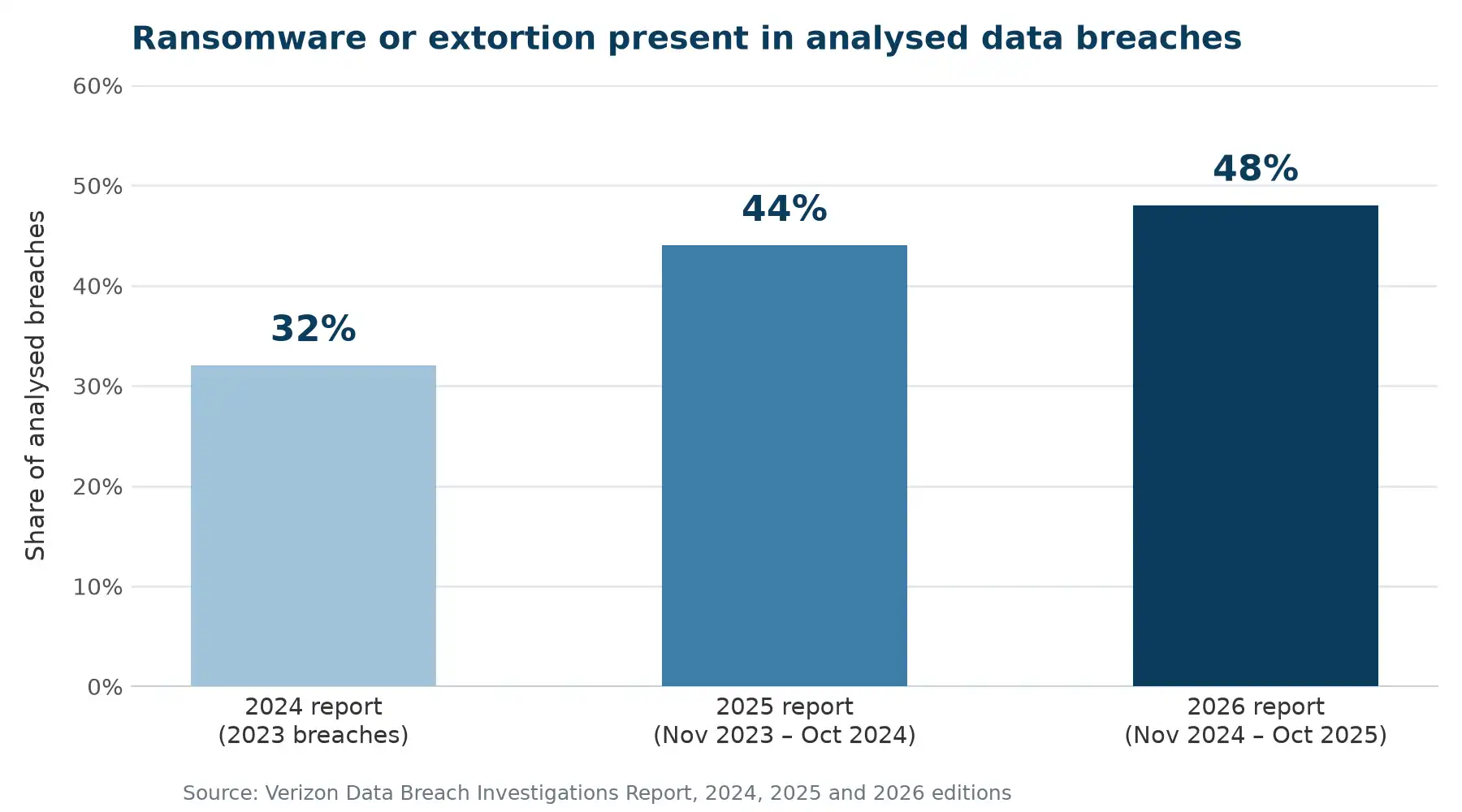
Ransomware or extortion present in analysed data breaches. Source: Verizon Data Breach Investigations Report, 2024, 2025 and 2026 editions.
Real protection rests on a few fundamentals. Backups must be isolated from the main network so they cannot be encrypted alongside everything else, and restores must be tested. Networks should be segmented so one compromised laptop cannot reach every server. Detection matters too, because attackers often spend days inside a network before triggering encryption. The #StopRansomware Guide is a clear, free reference, and if your data backup arrangements have never been tested, start there.
Credential theft and account takeover
The most efficient attack is not a break-in at all. It is a login. Information-stealing malware harvests saved passwords and session cookies from browsers, and those cookies are dangerous because they can let an attacker bypass a multi-factor prompt.
That does not make multi-factor authentication pointless. It remains one of the highest-value controls available, and Microsoft’s Digital Defense Report still shows it blocking the overwhelming majority of password-based attacks. It does mean phishing-resistant methods such as passkeys are becoming the standard for administrators and finance staff. It is also worth reviewing who has access to what, because dormant accounts and forgotten administrator rights turn up in almost every review.
Data breaches, patching and supplier risk
One of this year’s more significant findings is that exploitation of software vulnerabilities has overtaken stolen credentials as the most common initial access route, appearing in roughly 31 per cent of breaches. In plain terms, attackers are walking in through systems nobody updated. Internet-facing equipment deserves particular attention, because a weakness in a firewall, router or remote access appliance exposes everything behind it, which is why keeping firewalls and network security current is not a one-off project. Supplier risk matters too: if your accounting or payroll platform is breached, your data is exposed without your own network being touched.
Remote and hybrid work has widened the attack surface
When work happens across offices, homes and client sites, the traditional secure perimeter stops making sense. A personal laptop running out-of-date software, a home router still using its factory password or a shared co-working network can each become a route into business systems.
The practical answer is a zero trust mindset: verify every user and device, and grant the minimum access required. The zero trust maturity model sets this out in achievable stages. For smaller organisations it means managed devices, enforced encryption and remote access that does not hand out broad network privileges.
Where the main threats come from, and what stops each one first
| Threat | How it usually reaches a business | The control that stops it first |
| Phishing and business email compromise | A convincing email, SMS or call about a real invoice or a change of payment details | Verifying payment changes out of band, plus a second approver above a set value |
| Ransomware | An unpatched system or a stolen login, followed by days of quiet access before encryption | Isolated backups with a tested restore, plus network segmentation |
| Credential and session theft | Malware lifting saved passwords and session cookies straight from a browser | Phishing-resistant multi-factor authentication for administrator and finance accounts |
| Unpatched software | Automated scanning finding a known weakness in an internet-facing system | A patching schedule that covers network hardware as well as software |
| Supplier compromise | A breach at an accounting, payroll or industry platform that holds your data | Supplier security questions, notification terms and clarity on where data is held |
| Remote and hybrid access | An unmanaged personal device or home network reaching business systems | Managed devices, enforced encryption and least-privilege remote access |
Practical steps to prioritise now
You do not need an enterprise budget to become a harder target:
- Enable multi-factor authentication everywhere, starting with email, remote access and financial systems.
- Patch on a schedule. Operating systems, applications and network hardware all need one.
- Back up, isolate and test. An untested backup is an assumption, not a safeguard.
- Restrict administrator rights so everyday accounts cannot change security settings.
- Train your people and rehearse the response so everyone knows who to tell.
- Write down your incident plan, including who contacts customers, insurers and regulators.
The small business cyber security guidance from the UK’s National Cyber Security Centre and the widely used Essential Eight mitigations map closely to these priorities.
Why a proactive approach matters
Reactive security is expensive because the cost arrives all at once: recovery work, downtime, lost revenue, legal advice and reputational damage. Proactive security spreads that cost and changes the outcome. Monitoring catches unusual behaviour before it becomes an outage. Patching closes the door automated scanning would otherwise find. Tested backups turn a potential closure into an inconvenient day. The real objective is business continuity: not perfect protection, but the ability to keep trading when something goes wrong.
How ICTechnology can help
ICTechnology works with small and medium organisations to build practical, layered protection that suits real budgets and real teams. Through managed cyber security services, the team can assess your environment, identify the gaps that matter most, and keep controls running rather than leaving security as a once-a-year exercise.
That support typically covers system monitoring, security auditing and reporting, patch management, access control, backup oversight, firewall and network security, end-user training, and incident response. The aim is simple: reduce the likelihood of an incident, shorten the time it takes to detect one, and make recovery predictable.
Good security depends on people as much as products. The engineers and consultants looking after your systems are the ones who spot the unusual login at six in the morning, and that kind of day-to-day attention is a large part of why businesses stay with ICTechnology.
Frequently asked questions
What are the main cyber security threats businesses face in 2026?
The main threats are phishing and business email compromise, ransomware, credential theft, unpatched software, supplier breaches and attacks on remote work environments. Ransomware is the most disruptive, appearing in 48 per cent of analysed breaches; phishing is the most common starting point.
Why is business cyber security so important right now?
Because attacks are automated, indiscriminate and increasingly assisted by AI, so organisations of any size get targeted. The global average cost of a breach hit a record USD 4.99 million in 2026, and even a minor incident can cost days of downtime.
How can a business protect itself from ransomware?
Combine isolated and regularly tested backups, prompt patching, multi-factor authentication on email and remote access, network segmentation, and monitoring that spots unusual activity early. Paying a ransom is not a recovery strategy and offers no guarantee the data is returned.
What are the risks of ignoring cyber security?
Ignoring cyber security raises both the likelihood of an incident and the damage when one occurs. Realistic consequences include extended downtime, permanent data loss, fraudulent payments, notification obligations, higher premiums and lasting reputational harm.
What should a small business do first if it has no cyber security in place?
Start with the controls that cut the most risk for the least cost: multi-factor authentication on email and remote access, automatic updates, isolated backups with a tested restore, fewer administrator accounts, and staff who know how to report a suspicious message. Most organisations manage this in weeks.
When should a business seek professional IT support for cyber security?
When it holds customer or payment data, depends on systems it cannot afford to lose, has staff working remotely, must meet client or regulatory expectations, or lacks the expertise to manage security consistently. Help before an incident is far cheaper than help afterwards.
Final thoughts
The threats described here are not hypothetical, and they are not reserved for large organisations. What changed most in 2026 is the speed and scale of attacks, and how convincing they have become. The encouraging part is that the fundamentals still work: multi-factor authentication, consistent patching, tested backups, limited access rights and well-informed staff prevent the overwhelming majority of incidents. What separates organisations that recover quickly from those that struggle is rarely budget. It is preparation. If cyber security has been sitting on your list, a short conversation with ICTechnology will tell you where your real risks are.
Interested in a quote and consultation? Reach out to: [email protected]
Need managed cyber security support? Please reach out! [email protected]
Any other enquiries? Fill out our contact form here.