Cyber security risks construction businesses cannot afford to ignore

A supplier emails to say its bank details have changed. The message looks genuine, the invoice matches the job, and the payment goes out on Friday. On Monday, the real supplier calls asking where their money is.
Scenarios like this are why cyber security risks for construction deserve a place on every owner’s agenda. Builders and contractors handle progress payments, supplier bank details, contracts, tender pricing and plans across offices, site sheds and phones. That makes the industry a target for phishing, invoice fraud, ransomware and unauthorised access. Here’s what those threats look like, what they cost and which protections matter most.
Key takeaways
- Construction businesses are attractive targets because they move large sums of money, share files with many outside parties and work across several sites and devices.
- Invoice fraud prevention starts with one rule: confirm every change to bank details by phone, using a number you already hold rather than one from the email.
- A ransomware attack can lock drawings, schedules and accounts at once, so separate, tested backups are essential for getting projects moving again.
- Email security for business, including multi-factor authentication and spam filtering, stops many attacks before staff ever see them.
- A cyber security risk assessment shows where your biggest gaps are, so you fix the most likely problems first instead of guessing.
Why construction businesses are in the firing line
Criminals go where the money is, and construction offers plenty. A typical project involves dozens of suppliers and subcontractors, a steady stream of invoices and variations, and busy people approving things from site because the work can’t wait.
The national cyber security agency’s Annual Cyber Threat Report 2024–25 received a cybercrime report on average every six minutes, with the average self-reported cost per report reaching $56,600 for small businesses and $97,200 for medium businesses. A 2026 national cybercrime survey found most cybercrime still goes unreported, while more small and medium business operators said attacks had affected their staff and created legal or regulatory problems.
Builders face the same wider threats every growing business should plan for, just with more money and more people in the loop.
The construction industry cyber threats that do the most damage
Most incidents trace back to a handful of attack types, and knowing how each works makes them far easier to spot.
Phishing and stolen logins
Phishing messages trick people into clicking a link or typing their password into a fake login page. With a working email password, criminals can quietly read conversations about upcoming payments. Fake drawings and “urgent” invoices are common lures, and learning how to recognise a phishing email is one of the cheapest defences available.
Invoice fraud and payment redirection
Invoice fraud, also called business email compromise or payment redirection, happens when a criminal imitates a supplier, subcontractor or manager and asks for money to go to a new account. Construction suits this scam because large, regular payments are expected. The Targeting scams report for 2025 shows payment redirection caused $166.8 million in reported losses, the second-highest scam type by loss and up from $152.6 million in 2024.
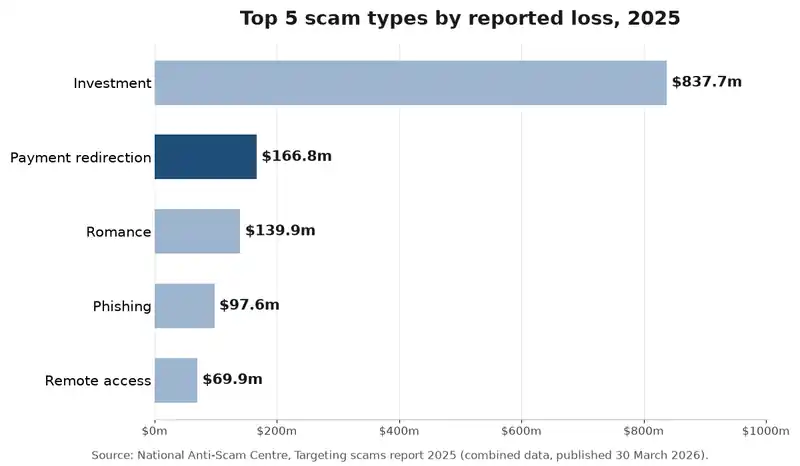
Source: National Anti-Scam Centre, Targeting scams report 2025
Official advice on protecting against business email compromise recommends multi-factor authentication, clear payment processes and verifying bank detail changes through a separate, trusted channel.
Ransomware
Ransomware encrypts your files and demands payment to unlock them, and attackers often steal data first. The same threat report found 11% of the incidents its responders handled involved ransomware. After a ransomware attack, construction teams can lose drawings, schedules, payroll and accounts at once, leaving crews waiting and deadlines slipping. Since many infections start with one careless click, teaching staff to avoid the mistakes ransomware relies on matters as much as software, and this primer on how ransomware works is worth sharing.
Unauthorised access
Shared passwords, former employees who still have accounts and subcontractors with old file links all create openings, as does a lost site tablet without a screen lock. Adding a second login step with multi-factor authentication means a stolen password alone isn’t enough to get in.
| Threat | How it shows up in construction | Key protection |
| Phishing | Fake drawings, delivery notices or login pages | Email filtering, staff training, multi-factor authentication |
| Invoice fraud | “New bank details” from a supplier or subcontractor | Phone verification and a second approver |
| Ransomware | Locked plans, schedules and accounting files | Updates, endpoint protection, separate and tested backups |
| Unauthorised access | Old accounts, shared passwords, lost devices | Individual logins, access reviews, device screen locks |
What a cyber incident can really cost
One redirected payment can wipe out a job’s profit, and the money is rarely recovered. The indirect costs often hurt more. Downtime stalls sites and can trigger contract penalties, while stolen employee or client details may create obligations under schemes such as notifiable data breaches. Head contractors and clients also ask how their information will be protected, so a public incident can cost future tenders as well as current revenue.
Practical protections every construction business should have
You don’t need an enterprise budget to close the most common gaps.
- Lock down payment changes. Build invoice fraud prevention into your process: call the supplier on a known number before changing bank details, and require a second approver for new payees.
- Strengthen email security. Turn on multi-factor authentication for every mailbox, use business-grade filtering and set up email authentication records that make your domain harder to spoof. Good filtering also removes the junk that buries genuine warnings in busy inboxes.
- Keep systems updated. Patch computers, phones and software promptly, using the Essential Eight as a respected baseline.
- Back up and test recovery. Keep one copy separate from your main network and practise restoring it. Understanding where backup ends and disaster recovery begins helps you plan to restart the whole business, not just retrieve files.
- Control access. Give everyone their own login and remove accounts when staff or subcontractors finish.
- Train your people. Short, regular sessions on phishing and payment requests turn staff into an early warning system.
- Plan your response. Decide who to call, how to isolate affected devices and where to report a cyber incident. The free small business cyber security handbook is a good starting point.
Why acting before an incident pays off
Most attacks exploit gaps that could have been closed earlier, and closing them costs a fraction of recovery. A cyber security risk assessment is the most efficient first step: it reviews your systems, accounts, devices and processes, then ranks the weaknesses so you know what to fix first. Threats keep evolving, with AI-generated phishing among the trends small businesses are watching in 2026, so security works best as a regular habit. Client portals and project apps are no exception, and designing data protection in from day one is far cheaper than retrofitting it. The government’s cyber security advice for businesses is also worth bookmarking.
How ICTechnology helps construction businesses reduce cyber risk
ICTechnology helps builders and contractors find and fix weak points before criminals do, and already provides IT support and website maintenance for formwork and structural contractors Future Form and Fastform.
Its cyber security services include cyber risk assessments, managed security services and penetration testing. Email and spam protection filters out phishing, viruses and malware, while its approach to protecting sensitive business data adds network monitoring, incident response and security awareness training for staff.
If ransomware or a failed device strikes, a data backup service covering online, local and external copies supports recovery. Managed IT services add proactive monitoring and a 24/7 service desk, so issues are caught early and help is always a call away.
With more than two decades of supporting business networks, ICTechnology’s engineers and security specialists provide support onsite and remotely, which suits teams spread across offices and job sites.
Frequently asked questions
What are the biggest cyber security risks for construction businesses?
The biggest risks are phishing, invoice fraud, ransomware and unauthorised access. They target the payments, supplier details, contracts and plans construction firms handle every day.
Why are construction companies targeted by cyber criminals?
They make frequent, large payments to many suppliers and share information across sites and devices, which makes fake invoices and stolen email accounts especially profitable.
How can a business prevent invoice fraud?
Verify every bank detail change by calling the supplier on a number you already have, and require a second approver for new payees. Multi-factor authentication on email adds another barrier.
What should a small construction business do first?
Turn on multi-factor authentication, automatic updates and separate, tested backups. Then book a cyber security risk assessment to prioritise the remaining gaps.
What happens if a business ignores cyber security?
It risks lost payments, project delays, data breaches and reputational damage. Recovery usually costs far more than prevention.
When should a construction business get professional IT security help?
Get help when you lack in-house IT expertise, after a suspicious payment request, or before taking on larger contracts. ICTechnology provides cyber risk assessments, email protection, backups and ongoing monitoring.
Protecting your projects, payments and reputation
Cyber criminals count on busy builders being too stretched to check one more email. Verifying bank details, protecting every mailbox, training staff and testing backups takes away most of their easy wins.
Pick one action this week, whether that’s switching on multi-factor authentication or writing down your payment verification process. Small steps keep your money, data and projects on track.
Interested in a quote and consultation? Reach out to: [email protected]
Need help with your existing IT systems? Please reach out! [email protected]
Any other enquiries? Fill out our contact form here.