What retail businesses need to know about online security
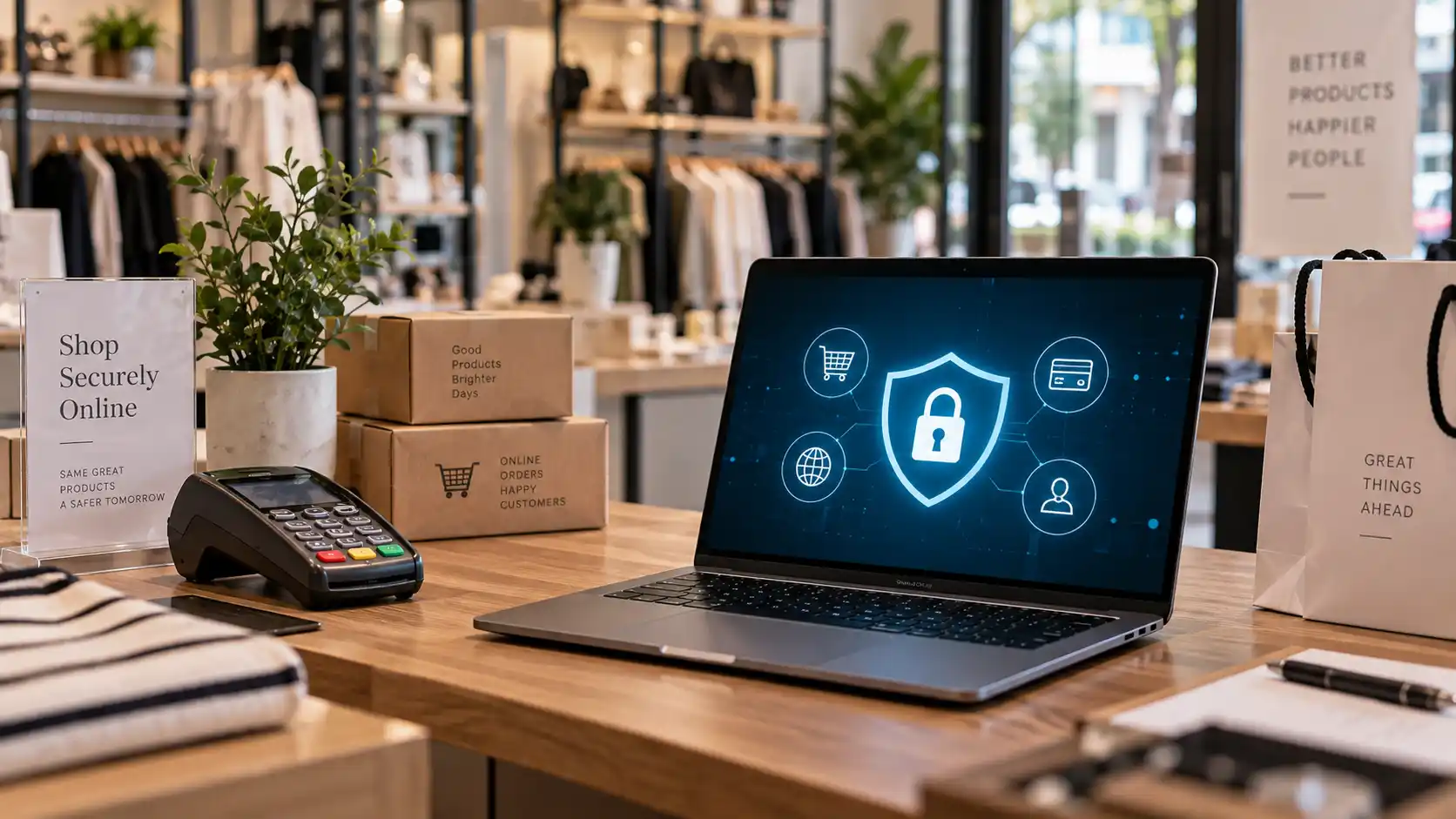
Online security in retail used to be a business of doors, keys and a cash drawer. Lock up at close, bank the takings, done. The modern version looks nothing like that. A single store might run an online shop, a payment gateway, a click-and-collect system, a supplier portal, a point-of-sale terminal and a customer database — most of it hosted elsewhere and reachable from anywhere.
That has been good for trade. It has also moved the front door of your business online, where it never closes and nobody is watching it unless you arrange for someone to.
Key takeaways
- Retail cyber security protects revenue and reputation, not just data — an outage during trading hours costs money like an empty shelf does.
- Phishing is the most reported entry point into small businesses, reaching retail teams through supplier invoices and refund requests.
- Weak or reused passwords on admin panels, payment gateways and email are an attacker’s cheapest way in.
- Online payment fraud has moved almost entirely to card-not-present channels — exactly where online stores operate.
- PCI DSS compliance applies to any business accepting card payments, including retailers using a hosted checkout.
- A retail data breach brings notification duties, card scheme scrutiny and lost trust, all of which outlast the clean-up.
Why online security is a retail problem, not just an IT one
Retailers are appealing targets for a simple reason: they hold money in motion and data at rest. Order histories, addresses, loyalty accounts and stored payment tokens sit in systems built to be easy for customers to reach — which makes them easy for attackers to probe.
Size offers no protection. ASD’s Annual Cyber Threat Report 2024–25 recorded more than 84,700 cybercrime reports in a year, with the average self-reported cost reaching about $56,600 for a small business and $97,200 for a medium one. Attacks also cluster around sale periods, when checkouts are busy and nobody has time to question an odd email — which is why businesses that come through intact treat online security as an operational discipline.
The main risks facing retail businesses online
Phishing and invoice fraud
Phishing remains the most common way attackers gain a foothold, and retail offers plenty of cover stories: a fake supplier invoice, a courier exception, a refund dispute, a payment-failed notice from a platform you genuinely use. It was the most reported scam type to Scamwatch in 2025, with over 65,000 reports and $97.6 million in losses, according to the National Anti-Scam Centre’s Targeting Scams report. These messages work by exploiting how quickly retail staff process routine email, so understanding how attackers target businesses matters more than any single product.
Weak, shared and reused passwords
Retail businesses accumulate logins faster than they manage them: website admin, payment gateway, email, supplier portals, POS back office. Somewhere along the way a shared password gets created “just for now” and stays for three years. Credential attacks succeed because people reuse passwords, so one unrelated breach elsewhere hands an attacker a working key. Long, unique passphrases in a password manager, plus multi-factor authentication on anything touching money or customer data, removes most of this risk.
Malware, ransomware and checkout skimming
Ransomware is the most disruptive malware a retailer will meet: an encrypted server mid-trade means no orders, no stock visibility and no payments, which is why tested backups matter as much as prevention.
Ecommerce security must also account for a quieter threat: malicious scripts injected into a checkout page that copy card details as customers type them. The site keeps working perfectly, which is the point — these attacks run for months unnoticed. Sites built on plugins and themes are especially exposed, so how a website is built and maintained is a security decision, not only a marketing one.
Online payment fraud
Chip technology made counterfeiting physical cards difficult, so fraud migrated to card-not-present transactions — the environment every online store operates in. The latest card fraud statistics show card-not-present fraud accounting for roughly 87 per cent of all card fraud in 2024–25. It rarely announces itself, appearing as a spike in chargebacks, mismatched billing and delivery addresses, or small repeated transactions testing stolen card numbers.
[Suggested chart: Bar chart showing payment card fraud by category, July 2024 – June 2025]
| Fraud category | Value |
| Card-not-present (overseas) | $434.3m |
| Card-not-present (domestic) | $312.0m |
| Lost and stolen cards | $74.3m |
| Total card fraud | $854m |
Source: AusPayNet fraud statistics, July 2024 – June 2025
What a retail data breach actually costs
The technical clean-up is the smallest part. A retail data breach sets off months of obligations: notifying customers, answering regulator questions, absorbing card scheme scrutiny and rebuilding systems. Volumes are rising too — the OAIC recorded 1,205 notifications in 2025, the highest annual total since mandatory reporting began. Trust takes longest to repair: customers forgive a late delivery far more readily than exposed card details, so protecting the data you hold is a commercial exercise.
Where PCI DSS compliance fits in
Any business that accepts, processes, stores or transmits card payments falls under the Payment Card Industry Data Security Standard. PCI DSS compliance is not optional and not only for large merchants — it applies to the corner store with a card terminal as much as the online shop using a hosted checkout.
The current version added requirements aimed squarely at online retailers, including an inventory of every script running on payment pages and a way to detect unauthorised changes to them. Those became mandatory in March 2025, and the PCI DSS documentation sets out what each merchant level must demonstrate. A hosted payment provider reduces your obligations, but does not remove them.
| Risk | How it shows up in retail | Control that reduces it |
| Phishing | Fake supplier invoice, refund or delivery email | Staff training, MFA, verified payment-change process |
| Credential theft | Admin or gateway login used from an unusual location | Unique passphrases, password manager, MFA |
| Malware / ransomware | Encrypted files, POS or website offline mid-trade | Patching, endpoint protection, tested offline backups |
| Checkout skimming | Card details stolen with no visible fault | Script inventory, change monitoring, managed hosting |
| Online payment fraud | Chargeback spikes, card testing, address mismatches | Fraud screening, 3-D Secure, transaction monitoring |
Practical steps retail businesses can take now
You do not need an enterprise budget to close the gaps behind most incidents:
- Turn on multi-factor authentication across email, website admin, the payment gateway and any cloud platform holding customer data.
- Give every person their own login, and remove accounts the day someone leaves. Shared logins make an incident impossible to investigate.
- Keep everything patched — website platform, plugins, POS software, browsers and operating systems. The Essential Eight strategies are a sensible baseline.
- Protect every device touching payments or customer data, including shop-floor tablets. Endpoint protection covers what a firewall no longer sees.
- Back up to a copy attackers cannot reach, and restore from it occasionally to prove it works.
- Brief your team on retail scams — invoice changes, refund requests and gift card fraud.
- Review access. Casual staff rarely need full customer records.
Why acting early costs less than reacting
Reactive security arrives as one badly timed bill, usually during your busiest week. Enabling MFA takes an afternoon; notifying thousands of customers is measured in months, on top of lost sales while systems are rebuilt. The controls that stop most attacks on businesses this size are not expensive — what changes is how quickly you notice. Monitoring that catches problems early is the difference between an alert on Tuesday and a shutdown on Saturday, and worth having before more advanced threats reach your checkout.
How ICTechnology supports retail businesses online
Knowing which controls matter is one thing. Keeping them working across a website, a payment platform, a POS system and a team that changes seasonally is another, particularly when nobody does IT full time.
Through managed cyber security services, ICTechnology covers endpoint protection, patching, email filtering, multi-factor authentication, monitoring and incident response, so suspicious activity is investigated rather than discovered later by a customer. Where the website is the exposure, secure hosting and properly configured firewalls and network security reduce the risk of a compromised checkout or an outage during peak trade, and access control systems apply the same discipline to stockrooms and comms cabinets.
Managed security for retail works best when someone knows your environment and your trading calendar — a large part of why businesses stay with ICTechnology, and why it helps to have engineers who spot an unusual login before it becomes an incident.
Frequently asked questions
What is retail cyber security?
Retail cyber security is the practice of protecting the systems a retail business depends on — website, online store, payment systems, customer database, email and devices — from attacks, fraud and data loss. It combines controls such as patching, multi-factor authentication and monitoring with staff awareness.
Why is online security important for retail businesses?
Because retailers hold customer and payment data in systems that must stay available to make money. A compromised checkout, ransomware outage or leaked database causes lost sales, notification obligations and lasting damage to customer trust.
How can small retail businesses protect themselves online?
Start with multi-factor authentication on every account touching money or customer data, unique passwords for each system, automatic updates on the website and devices, endpoint protection on anything handling payments, and tested backups.
What are the risks of ignoring ecommerce security?
Ignoring ecommerce security leaves an online store open to checkout skimming, credential theft and payment fraud that can run undetected for months. Likely outcomes are a retail data breach, chargeback costs, downtime during peak trade, and lost customers.
Does PCI DSS compliance apply to small retailers?
Yes. PCI DSS compliance applies to any business that accepts, processes, stores or transmits card payments, regardless of size. Merchants using a hosted payment provider have a lighter validation path, but remain responsible for their website, accounts and devices.
When should a retail business get professional IT support for security?
When it takes payments online, stores customer data, runs more systems than one person can track, or cannot say whether its site and accounts are monitored. Managed security for retail is almost always cheaper than incident recovery.
Where to start with retail security
Retail has always involved managing risk — shrinkage, spoilage, seasonal demand. Online security is the same discipline applied to a different part of the business: know what you have, watch it, and fix the obvious weaknesses before they cost you. The essentials are reassuringly ordinary, and multi-factor authentication, individual logins, current software, protected devices and reliable backups will stop most attacks aimed at retailers of your size. If you are unsure where your store sits today, a short conversation with ICTechnology is a sensible place to begin.
Interested in a quote and consultation? Reach out to: [email protected]
Need help securing your retail systems? Please reach out! [email protected]
Any other enquiries? Fill out our contact form here.