Protecting customer data in retail websites and online stores
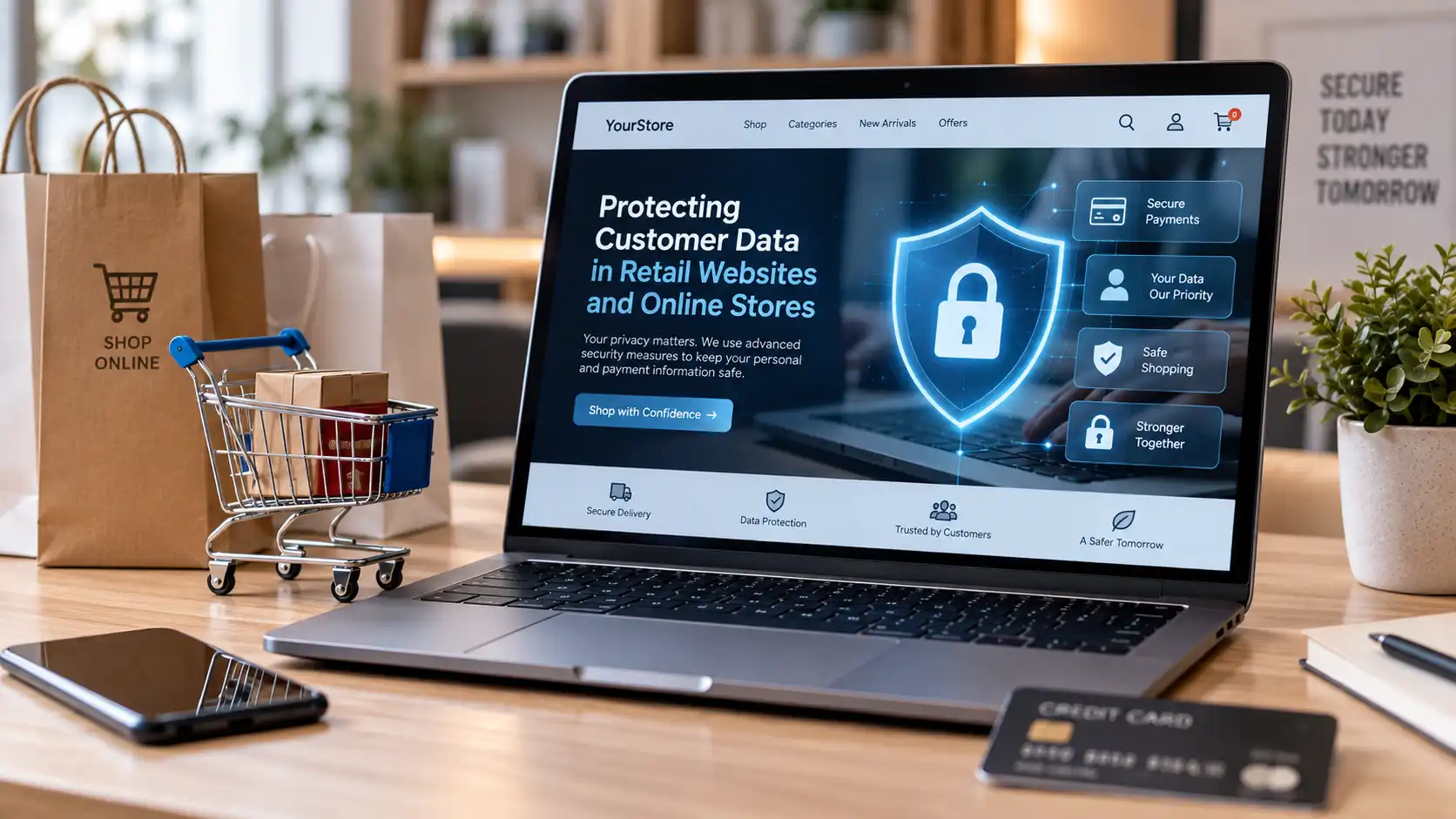
Every online order leaves a trail. A name, an email address, a delivery address, an order history and sometimes a stored card token — gathered in seconds at checkout, then scattered across a website database, an email platform, a shipping tool and a spreadsheet somebody exported two years ago and never deleted.
Most retailers file that information under admin. Attackers treat it as inventory. Customers treat it as a test, and they hand over details far more readily to a business that looks like it knows where that data goes.
Key takeaways
- Customer data protection is a commercial safeguard, not only a technical one — retail records are valuable to attackers and impossible to replace once exposed.
- A secure checkout process depends on more than the payment gateway; the plugins, scripts and admin logins around it are where online store security usually fails.
- Shared logins and loose access controls are the easiest way in, and they make an incident almost impossible to investigate.
- Data you no longer need is still data you can lose — deleting old records is cheap data breach prevention.
- Privacy Act compliance covers what you hold, how it is secured and how long you keep it, and reform is tightening those expectations.
- Around two thirds of people say they would use digital services more if they trusted how their information was handled.
Why customer data is the most valuable thing your online store holds
Stock can be reordered. Customer records cannot. A retail database holds identity details that stay useful to criminals long after a stolen card is cancelled — addresses for parcel redirection fraud, email addresses for targeted phishing, and order histories convincing enough to make a fake refund call sound genuine.
The numbers reflect that value. The OAIC recorded 1,205 data breach notifications in 2025, an 8% rise and the highest annual total since mandatory reporting began, with malicious or criminal activity behind roughly 59%. Size offers no shelter: the Annual Cyber Threat Report 2024–25 logged over 84,700 cybercrime reports, with the average self-reported cost reaching about $56,600 for a small business and $97,200 for a medium one.
Retailers are appealing targets because they hold consumer data in systems built to be open to the public, which is why protecting the data you hold sits alongside protecting revenue.
Where retail websites actually leak customer data
The checkout, and everything around it
A secure checkout process is rarely broken at the payment gateway itself. It fails at the edges: an outdated plugin, an unmonitored tracking script, an analytics tag an agency added three years ago. Malicious code injected into a payment page copies card and contact details as customers type them, while the site keeps working perfectly. That silence is the point — skimming can run for months unnoticed.
Access controls and shared logins
Retail teams accumulate logins faster than they retire them: website admin, email, shipping, loyalty, supplier portals. Someone needs access on a Saturday, a shared password appears, and it survives three years. Shared accounts fail twice over — they hand attackers a working key, and they make it impossible to establish who did what. That discipline belongs in the admin panel, because attackers look for exactly these gaps.
Data you have stopped needing
Most online stores hold years of untouched order records, exported customer lists sitting in inboxes, and old CSV backups on a staff laptop. Every copy is a liability with no commercial upside. Regulators are explicit: APP 11 requires reasonable steps to destroy or de-identify personal information once it is no longer needed.
Third-party tools and integrations
Stores run on connections — payment providers, review widgets, chat tools, marketplace feeds, accounting sync. Each is a door into your customer data, and each vendor’s security quietly becomes part of yours. How integrations move data between systems is part of your own risk picture, particularly as threats aimed at growing businesses become more automated.
What customers expect before they trust you with their details
Data protection is also a conversion issue. Research published by the OAIC found 87% of people are more concerned about privacy than five years ago, and 68% would be more likely to use digital services if they knew their information was handled fairly. Most accept data collection — but on conditions.
[Suggested chart: Bar chart showing what makes data collection acceptable to consumers]
| Condition | Share who say it makes collection acceptable |
| The purpose of collection is clear | 69% |
| Consent or opt-in is offered | 68% |
| Collection is limited to what is necessary | 66% |
| Non-essential data can be opted out of | 61% |
Source: Australian Community Attitudes to Privacy Survey 2026, OAIC, May 2026
Read that as a design brief. Asking for less, explaining why, and proving it is both sound online security practice and good retail.
Where privacy compliance fits in
Australian Privacy Act compliance is not a document you produce once. It is an ongoing obligation to hold personal information securely, collect only what you genuinely need, and dispose of it when its purpose has passed. A privacy policy that does not describe what the business actually does is itself a compliance problem.
Expectations are tightening. The exposure draft of the Privacy Amendment (Personal Data Protection) Bill 2026, released for public consultation in August 2026, proposes a “fair and reasonable” test for handling personal information alongside stronger breach response duties. Retailers already practising sensible compliance and data handling will find that far less disruptive than starting from scratch.
Practical steps retail businesses can take now
| Risk | How it shows up in an online store | Control that reduces it |
| Checkout skimming | Card details stolen with no visible fault | Script inventory, change monitoring, secure hosting |
| Credential theft | Admin login used at an odd hour or location | Individual logins, password manager, multi-factor authentication |
| Excess data retention | Years of orders and exports nobody uses | Retention schedule, scheduled deletion, encryption |
| Vulnerable plugins | Site compromised through an outdated extension | Patching, vendor review, managed updates |
| Ransomware | Store offline mid-trade, records encrypted | Endpoint protection, tested offline backups |
| Human error | Customer list emailed to the wrong recipient | Staff training, least-privilege access, data loss controls |
Five habits do most of the work:
- Turn on multi-factor authentication for website admin, email, the payment platform and any cloud service holding customer records. The Essential Eight treats this as a baseline, not an upgrade.
- Give every person their own account, and remove it the day they leave.
- Collect less, and keep it for less time. Write down what you hold, where it lives and when it gets deleted — the guidance on securing customer personal data is a practical starting point.
- Keep the site patched — platform, theme, plugins, integrations — and remove anything unused. Dormant plugins still run code.
- Back up to a copy attackers cannot reach. A 3-2-1 backup approach turns ransomware into an inconvenience, and endpoint protection covers the devices those backups come from.
Why acting early costs less than reacting
Data breach prevention is unglamorous and cheap. Breach response is neither. Enabling multi-factor authentication and clearing out stale accounts takes an afternoon; notifying customers, answering regulator questions and rebuilding trust is measured in months.
The gap between a contained incident and a public one is almost always how quickly it is spotted. Monitoring that flags unusual activity early separates a quiet Tuesday fix from a weekend of notifications, and matters most against the threats businesses are preparing for now.
How ICTechnology supports retail businesses with customer data
Knowing which controls matter is one thing. Keeping them working across a website, a payment platform, a marketing stack and a team that changes seasonally is another, especially when nobody does IT full time.
ICTechnology’s cyber security services cover the parts of customer data protection that have to run continuously: endpoint protection, patching, multi-factor authentication, privilege management, monitoring and incident response. Where the store itself is the exposure, secure web hosting and properly configured firewalls and network security reduce the risk of a compromised checkout or an outage during peak trade, while managed backup keeps a bad day recoverable. Offline, access control systems apply the same least-privilege thinking to stockrooms and comms cabinets.
Website security services work best when someone knows your environment and your trading calendar — a large part of why businesses stay with ICTechnology, and why it helps to have engineers who notice an unusual login before a customer does.
Frequently asked questions
What is customer data protection in retail?
Customer data protection is the practice of securing the personal information a retail business collects — names, contact and delivery details, order histories and payment data — across its website, online store and connected systems. It combines technical controls such as access management, patching and encryption with habits like collecting less and deleting it when it is no longer needed.
Why is online store security important for small retail businesses?
Because small stores hold the same categories of customer data as large ones, with far fewer people watching them. One compromised admin account or outdated plugin can expose an entire customer database, triggering notification obligations, lost sales and a loss of trust that outlasts the clean-up.
How do I make my checkout process more secure?
Use a reputable hosted payment provider so card data never touches your own servers, keep an inventory of every script running on payment pages, monitor those pages for unauthorised changes, enforce multi-factor authentication on admin and gateway logins, and patch promptly.
What are the risks of ignoring data breach prevention?
Ignoring data breach prevention leaves customer records exposed to credential theft, checkout skimming and ransomware, often undetected for months. The likely outcomes are mandatory notifications, regulator scrutiny, chargeback costs, downtime during peak trade, and customers who do not come back.
What does Australian Privacy Act compliance require an online retailer to do?
Australian Privacy Act compliance requires retailers to collect only the personal information they reasonably need, tell customers what is collected and why, take reasonable steps to keep it secure, and destroy or de-identify it once its purpose has passed. Businesses must also be able to respond to a breach and notify affected people where serious harm is likely.
When should a retail business get professional help with website security?
When it takes payments online, stores customer records, runs more systems than one person can track, or cannot confidently say who has access to what. Website security services and managed monitoring are almost always cheaper than recovering from a breach.
Where to start with customer data
Retailers have always managed risk — shrinkage, spoilage, seasonal demand. Protecting customer data is the same instinct applied to something you cannot see on a shelf: know what you hold, keep only what you need, control who can reach it, and watch for the moment something changes.
None of that needs an enterprise budget. Individual logins, multi-factor authentication, current software, a sensible retention rule and reliable backups will stop most attacks aimed at stores your size. If you are unsure what your systems are holding today, a short conversation with ICTechnology is a sensible place to begin.
Interested in a quote and consultation? Reach out to: [email protected]
Need help protecting your customer data? Please reach out! [email protected]
Any other enquiries? Fill out our contact form here.