Local SEO tips for retail stores looking to increase foot traffic & online sales
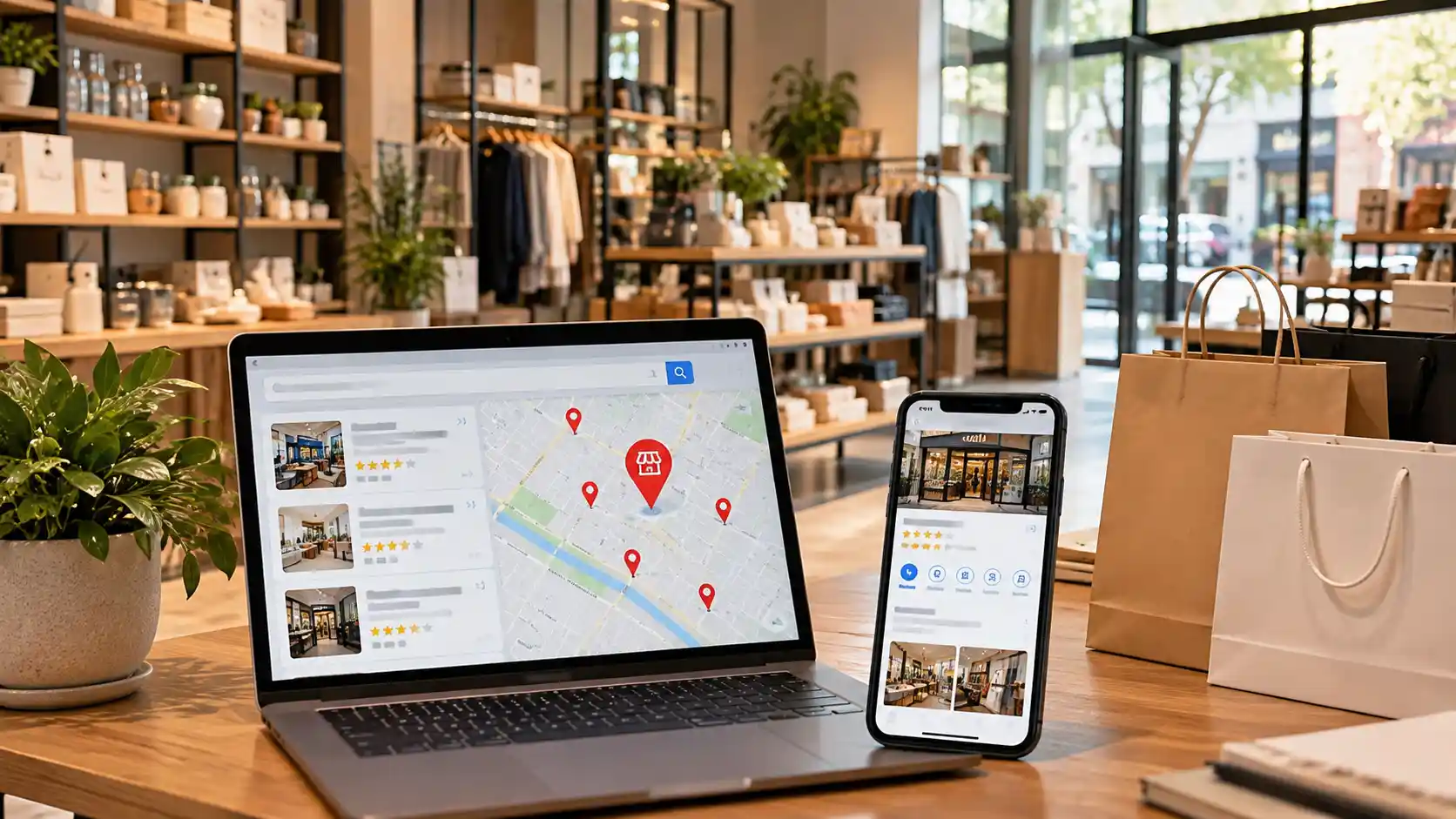
Think about the last time you needed something in a hurry: a birthday present, a phone charger, new running shoes. You probably picked up your phone, typed what you wanted and added “near me”. Within seconds, a map appeared with a handful of shops, their star ratings, opening hours and a button for directions.
That short list is where many retail sales are now won or lost. If your store appears with accurate details and good reviews, you are in the running. If it does not, the customer walks into a competitor’s shop without knowing you existed. Local SEO for retail stores is how you earn a place on that list, and it shapes both foot traffic and online orders.
Key takeaways
- Local SEO helps a retail store appear when nearby shoppers search for what it sells, including in Google Maps and the map results at the top of Google Search.
- Google ranks local results on three factors: relevance, distance and prominence. Retailers cannot pay for a better local search ranking, but they can influence relevance and prominence.
- Google Business Profile optimisation is the fastest win: verified details, accurate hours, the right category, real photos and regular updates.
- NAP consistency (the same business name, address and phone number everywhere) builds trust with both search engines and customers.
- Online reviews for local business affect visibility and buying decisions, so ask for them regularly, reply to them and never fake them.
What local SEO means for a retail store
Local SEO is the practice of improving how a business appears in location-based search results. When someone searches “gift shop near me” or “running shoes in Richmond”, search engines show a map with a small group of businesses above the standard results. Local SEO is about getting your store into that group.
It builds on the same principles as general search engine optimisation, but with a geographic layer. Instead of competing with every retailer online, you compete with stores near the shopper, a far more winnable contest for a small business and one reason SEO belongs in every business’s digital survival kit.
Google’s guidance on improving local ranking names three factors, and states plainly that there is no way to pay for a better local ranking.
| Ranking factor | What Google looks at | What a retailer can control |
| Relevance | How well a Business Profile matches the search | Categories, product details, descriptions and website content |
| Distance | How far the business is from the searcher or the searched location | Accurate address and location pages (you cannot move the shop) |
| Prominence | How well-known the business is, including reviews, ratings and links | Reviews, responses, local mentions and a well-regarded website |
Source: How to improve your local ranking on Google, Google Business Profile Help
Why near me searches matter more than ever
Near me searches carry strong buying intent. Someone searching “hardware store near me” is rarely browsing for fun. They usually want to buy today and are choosing where to go.
Phones have made this behaviour routine. ACMA research released in February 2026 found 97% of adults went online using a mobile phone in 2025. At the same time, online shopping keeps growing: the eCommerce Report 2026 found 82% of households shopped online in 2025, with 24% of all retail spend now made online.
These trends work together. Many shoppers research on their phone, then visit the store; others find a local shop in search and order online for delivery or click and collect. That is why local visibility and a mobile-first retail website work best together, and why some retailers go further with a mobile app that supports business growth.
What poor local visibility costs retailers
Weak local SEO is easy to miss because you never see the customers who did not find you. It usually shows up in familiar ways.
- Missing from the map. Incomplete or unverified profiles lose the top spots to competitors, even when your store is closer.
- Wrong information. Outdated hours send customers to a locked door, and that frustration often becomes a poor review.
- Thin or stale reviews. Three reviews from 2022 look less trustworthy than a steady flow of recent feedback.
- A website that lets people down. Visibility means little if the site is slow, confusing or insecure, one of the serious ways a bad website damages a business.
Reviews also shape how businesses behave. A government-commissioned national consumer survey, conducted by Kantar Public in 2023, found 73% of businesses agreed the possibility of negative reviews on review sites and social media has influenced businesses to take complaints more seriously.
Practical local SEO tips for retail stores
Most local SEO work is practical, affordable and within reach of any store owner. Start with these five areas.
1. Complete and optimise your Google Business Profile
Google Business Profile optimisation is usually the quickest win. Claim and verify your profile, choose the most accurate primary category (“Shoe store” rather than “Store”) and complete every field, including address, phone, website, hours and attributes.
Keep holiday hours current, upload real photos of your shopfront and products, and post updates about new stock, events or sales. Google also encourages retailers to showcase in-store products where available.
2. Keep your NAP consistent everywhere
NAP consistency means your business Name, Address and Phone number appear exactly the same everywhere: your website footer, Google Business Profile, social media, Apple Maps, Bing Places and directories.
Small differences, such as “St” versus “Street” or an old number on a forgotten directory, create doubt for search engines and customers. Make sure your name matches your registered business details and update listings whenever something changes.
3. Use location-based keywords naturally
Location-based keywords tell search engines where you trade. Include your suburb or city in page titles, headings and descriptions where it reads naturally, such as “Homewares store in Brighton”.
Give each location its own page with address, hours, a map and a few words about the area, but avoid stuffing suburb names into every sentence. This is where SEO built into web development from the start makes a noticeable difference.
4. Build and respond to online reviews
Online reviews for local business influence both prominence and the decision to visit. Make reviewing easy with a link in follow-up emails, a QR code at the counter and a friendly request from staff.
Reply to every review promptly and professionally. The business.gov.au guide to online reviews recommends thanking happy customers and offering solutions to unhappy ones. And stay on the right side of the law: the ACCC’s guidance on online reviews makes clear that fake reviews, rewards only for positive reviews and removing genuine negative feedback can mislead consumers.
5. Make your website work for local shoppers
Your website supports your local search ranking and turns visibility into sales. It should load quickly on a phone, show your address and hours, embed a map and let shoppers check stock, buy online or choose click and collect.
Local business structured data (schema markup) helps search engines read your details accurately. Thoughtful web design and development brings this together, while understanding online security risks for retail businesses and protecting customer data in your online store keep shoppers confident enough to buy.
| Local SEO task | Why it matters | How often to review |
| Verify and complete Google Business Profile | Makes your store eligible and relevant for local results | Once, then monthly |
| Check NAP consistency across listings | Builds trust with search engines and customers | Quarterly, or whenever details change |
| Request and reply to reviews | Improves prominence and customer confidence | Weekly |
| Review local keywords and store pages | Keeps relevance aligned with how people search | Quarterly |
| Test website speed on mobile | Stops local visitors leaving before they buy | Quarterly |
Why a proactive approach to local search pays off
Local SEO is not a one-off project. Hours change, competitors open down the road and search engines refine their results. A profile that ranked well last year can slide quietly until sales dip.
Being proactive means checking listings on a schedule, tracking calls, direction requests and website visits from search, and acting on the numbers. The business.gov.au guide to measuring your digital performance is a useful start. If you are starting a business, a clean local presence belongs among your tech essentials for early-stage businesses, because fixing messy listings later takes far longer.
How ICTechnology helps retailers get found locally
Knowing what strong local SEO looks like is one thing; managing it while running a store is another. ICTechnology’s web development services cover responsive, mobile, custom and e-commerce website development, with SEO-friendly builds for new and growing businesses. Its SEO support includes website audits, keyword strategy, local SEO optimisation, technical SEO and ongoing reporting.
With more than 20 years of experience supporting clients’ IT and network infrastructure, ICTechnology also offers web hosting options that help keep your site fast and stable. It is part of why businesses choose ICTechnology: a team of specialists who act as an extension of your business.
Frequently asked questions
What is local SEO for retail stores?
Local SEO for retail stores is the process of improving a store’s visibility in location-based search results, such as Google Maps and map listings in Google Search. It covers Google Business Profile optimisation, accurate business details, reviews and local website content.
Why are near me searches important for retailers?
Near me searches matter because they come from shoppers ready to buy nearby, often the same day. Appearing in them puts your store in front of customers as they decide where to shop.
How do I optimise my Google Business Profile?
Verify your profile, choose the most accurate primary category and complete every field, including hours, phone and website. Then add real photos, post updates, keep holiday hours current and respond to reviews.
What is NAP consistency and why does it matter?
NAP consistency means your business name, address and phone number are identical across your website, Google Business Profile, social media and directories. Consistent details help search engines trust your information and stop customers calling old numbers.
Do online reviews affect local search ranking?
Yes. Google lists reviews and ratings among the signals of prominence, one of its three local ranking factors. Reviews also influence whether shoppers choose you, so ask for genuine reviews and reply professionally.
When should a retailer get professional help with local SEO, and can ICTechnology help?
Seek help when your store is missing from local results, you manage several locations, or your website is slow or hard to update. ICTechnology provides SEO-friendly web development, local SEO optimisation, technical SEO and web hosting to help retailers improve their online presence.
Putting your store on the local map
Every day, shoppers near your store search for what you sell. Local SEO decides whether they find you or someone else.
A complete Google Business Profile, consistent details, genuine reviews and a fast, locally focused website will lift both foot traffic and online orders for stores of any size. If you are not sure how your business looks in local search today, a conversation with ICTechnology is a sensible first step.
Interested in a quote and consultation? Reach out to: [email protected]
Need help with your retail website? Please reach out! [email protected]
Any other enquiries? Fill out our contact form here.