The Cost of IT Downtime During EOFY in Financial Services
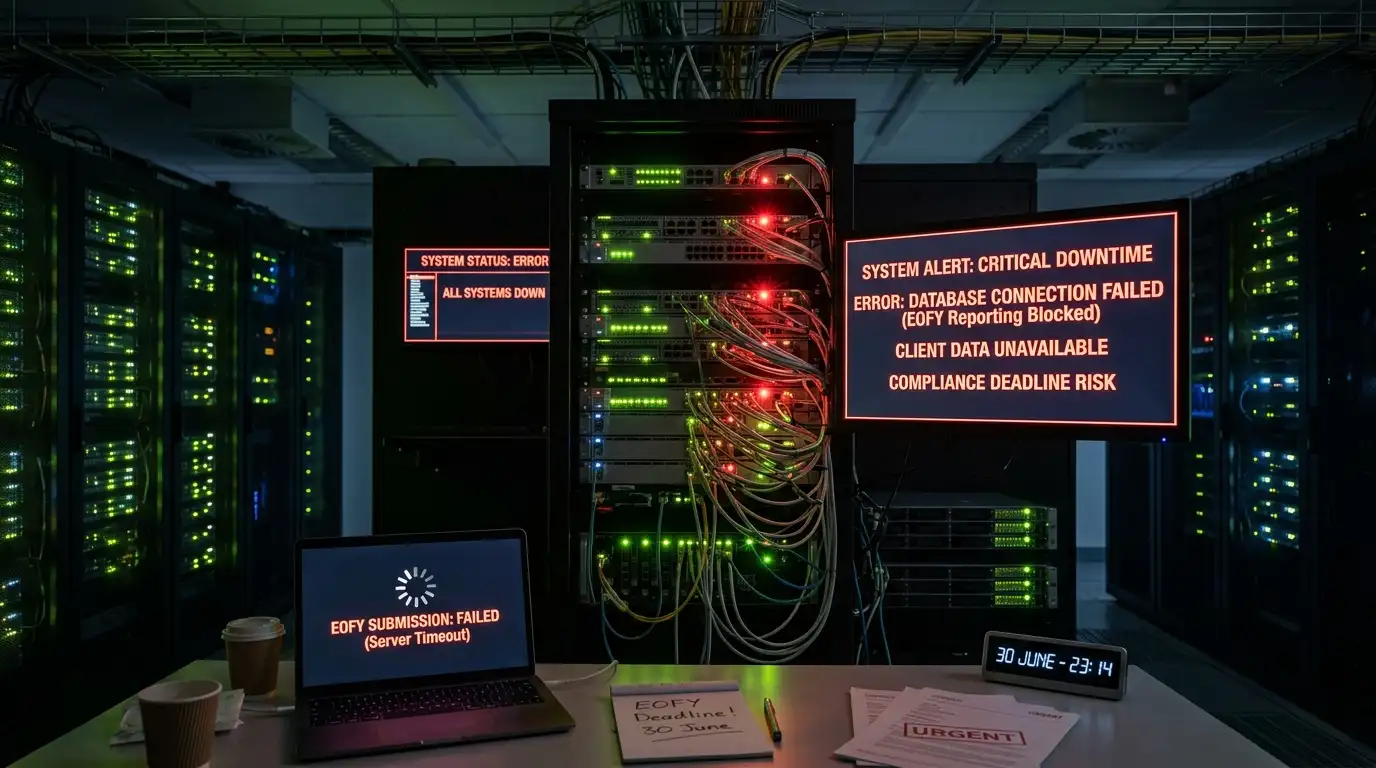
EOFY is one of the busiest and most pressure filled periods for financial services businesses. Reports need to be finalised. Client records need to be accurate. Transactions need to be processed. Systems need to be available. Teams are often working to tight deadlines, while clients expect fast updates, smooth communication and reliable service.
In most countries, the end of financial year is not just another date in the calendar. It is a period where compliance, reporting, tax preparation, payroll, invoicing, audits and client service all come together at once. For financial advisers, accountants, brokers, lenders, insurance providers and other finance related businesses, even a short IT outage can quickly become more than a technical issue.
For businesses that rely on technology to manage clients, reporting, communications and day-to-day operations, having the right IT foundation matters. ICTechnology supports businesses with practical IT services, reliable systems and ongoing support, helping them build stronger technology environments that can handle busy periods with more confidence.
Downtime during EOFY can delay reporting, interrupt client communication, affect cash flow and create unnecessary pressure on teams who are already dealing with time sensitive work. It can also expose deeper weaknesses in a business’s technology environment, from outdated systems and poor backup processes to limited monitoring and unclear recovery plans.
For many small and medium financial services businesses, the real cost of downtime is not always obvious until it happens. A system goes offline. A shared drive becomes inaccessible. A cloud platform has login issues. Emails stop sending. A finance application crashes. A server slows down. At first, it may feel like a temporary inconvenience. But during EOFY, every hour matters.
Why EOFY Downtime Is More Expensive Than It Looks
The first cost of downtime is usually lost productivity. If staff cannot access files, applications, emails, client records or financial platforms, work slows down or stops completely. During quieter periods, a temporary delay may be manageable. During EOFY, it can create a domino effect across the whole business.
A reporting delay can push back internal reviews. A payroll issue can affect employee payments. A system outage can delay invoicing. A failed backup can make it harder to recover important information. A network problem can stop teams from accessing cloud applications. In financial services, where accuracy and timing are both essential, these delays can carry serious consequences.
There is also the cost of rework. When systems fail, staff may turn to manual workarounds such as spreadsheets, handwritten notes, duplicated files or offline records. While this may help temporarily, it often creates version control problems, data entry mistakes and extra admin later. Once systems are restored, teams then need to reconcile what was completed manually with what exists in the system.
Downtime can also increase stress across the business. EOFY already places pressure on staff, especially when teams are managing client expectations, reporting deadlines and compliance requirements. When technology fails, that pressure increases. Staff may work longer hours, make more mistakes or struggle to maintain normal service standards.
The financial impact can also include missed revenue opportunities. For example, if a client enquiry is delayed, a proposal is not sent on time, or a payment process is interrupted, the business may lose momentum. In competitive financial services environments, clients often expect responsiveness. A lack of availability at the wrong time can influence whether they continue to trust the business.
The Compliance Risk Behind System Interruptions
For financial services businesses, downtime is not only a productivity issue. It can also become a compliance and operational risk issue.
Regulators increasingly expect financial services organisations to understand their operational risks, maintain business continuity plans and manage technology related disruptions. Prudential guidance for regulated entities includes expectations around maintaining critical operations through disruption, having credible business continuity plans and managing service provider risks.
This matters because many financial services businesses rely on digital systems to meet obligations. Client communication, document storage, identity records, transaction history, advice files, reporting data and audit trails are often stored across cloud platforms, line of business applications, email systems and shared drives.
When these systems become unavailable, the business may struggle to prove what happened, when it happened and how it was managed. If the downtime involves a cyber incident or data breach, the responsibilities become even more serious. Under the Notifiable Data Breaches scheme, covered organisations must notify affected individuals and the privacy regulator when a breach involving personal information is likely to result in serious harm.
The risk is not limited to large enterprises. Small and medium businesses often hold sensitive client information, including identification details, income documents, tax records, insurance information, financial statements and contact details. If systems are not properly protected, monitored and backed up, an outage can quickly become a data security concern.
The latest Notifiable Data Breaches reporting showed 595 notifications in the July to December 2024 period, with malicious or criminal attacks accounting for 69 percent of reported breaches. Phishing was also identified as a leading cyber incident source.
For financial services firms, this reinforces a simple point: downtime and cyber risk often overlap. A ransomware event, compromised account, failed update or unauthorised access incident can all result in system unavailability. The business then needs to manage both recovery and compliance at the same time.
The Client Trust Cost
Financial services are built on trust. Clients share sensitive information because they expect it to be handled carefully, securely and professionally. When technology fails, that trust can be tested.
A client may be understanding if a system issue happens once and is resolved quickly. But if downtime affects urgent matters, delays important communication or creates uncertainty around sensitive documents, confidence can drop.
For example, imagine a client waiting on EOFY documentation to finalise their own reporting. They contact their adviser or accountant for an update, but the team cannot access the file because the server is down. Another client may be waiting for confirmation that a payment, lodgement or document has been processed. If email is unavailable or the system is slow, communication becomes difficult.
Even if the issue is fixed later, the client remembers the delay. They may not know whether the outage was caused by a network issue, a failed backup, a cyber event or a software problem. They only know that when they needed support, the business was not fully available.
This is where downtime becomes reputational. It does not always show immediately in a profit and loss report, but it can affect client retention, referrals and confidence. For SMEs trying to grow in a competitive market, reputation is one of the most valuable assets they have.
Common Causes of EOFY Downtime
Downtime often feels sudden, but the causes usually build up over time. EOFY simply exposes the weak points because systems are under heavier demand.
One common cause is outdated infrastructure. Servers, devices, networking equipment and software that have not been maintained properly may struggle during busy periods. Older systems may also be harder to patch, harder to integrate and more vulnerable to failure.
Another cause is poor backup and recovery planning. Many businesses assume they have backups, but they have not tested whether those backups can actually restore the right data quickly. A backup is only useful if it is complete, secure, recent and recoverable.
Cyber incidents are another major cause. Phishing, compromised credentials, malware and ransomware can all lead to downtime. Financial services businesses are attractive targets because of the type of data they hold. If staff are busy during EOFY, they may also be more likely to click quickly, approve requests without checking properly or miss warning signs.
Software updates can also create disruption when they are not managed carefully. Updates are important, but applying them at the wrong time or without testing can interrupt critical workflows. The same applies to poorly planned system changes, cloud migrations or application integrations.
Network issues are another hidden cause. A business may have strong software platforms, but if its internet, WiFi, firewall, switches or remote access setup is unreliable, staff can still experience downtime. Hybrid teams and cloud based systems depend heavily on stable connectivity.
Finally, many businesses do not have clear incident response processes. When something fails, staff are unsure who to contact, what to prioritise, how to communicate with clients or how to keep working safely. This confusion can make downtime last longer than it should.
How to Reduce Downtime Before EOFY Pressure Peaks
The best way to reduce EOFY downtime is to prepare before systems are under pressure. Waiting until something breaks usually costs more, creates more stress and leaves fewer options.
A good starting point is to review business critical systems. This includes accounting platforms, client management systems, document storage, email, payment systems, payroll, backup tools, internet connections and security platforms. Businesses should understand which systems are most important, who relies on them and what happens if they are unavailable.
Monitoring is also essential. Proactive monitoring can detect warning signs before they become outages. This may include storage issues, failed backups, device health alerts, unusual login activity, network instability or server performance problems.
Backup testing should also be part of EOFY preparation. It is not enough to know that backups exist. Businesses should confirm what is being backed up, how often backups run, where they are stored, how quickly they can be restored and whether they are protected from ransomware.
Security controls should also be reviewed. Multi factor authentication, endpoint protection, patch management, staff awareness, access permissions and email security all help reduce the likelihood of cyber related downtime. ASIC guidance also highlights the importance of cyber resilience and proper management of cyber risk for financial sector organisations.
Businesses should also have a clear business continuity plan. This does not need to be overly complicated, but it should explain what happens if systems go down. Who makes decisions? Who contacts the IT provider? Which systems are restored first? How will clients be updated? What manual processes are acceptable? How will data be reconciled afterwards?
A strong plan reduces panic. It gives staff direction and helps the business recover faster.
How ICTechnology Helps Reduce EOFY Downtime Risk
This is where the right technology partner can make a practical difference.
ICTechnology supports businesses by helping them move from reactive IT support to a more proactive, prepared and resilient approach. Instead of waiting for systems to fail, the focus is on identifying risks early, strengthening weak points and putting the right continuity measures in place before EOFY pressure builds.
Through proactive monitoring, ICTechnology can help detect issues such as device health problems, backup failures, network interruptions, security alerts and system performance concerns. This gives businesses better visibility over their environment and helps reduce the chance of small issues turning into major outages.
Reliable backup solutions are also central to downtime prevention. ICTechnology can help businesses review their backup setup, improve data protection, support cloud and offsite backup strategies and ensure important information can be recovered when needed.
Business continuity planning is another important part of the process. ICTechnology can assist businesses in understanding their critical systems, planning recovery priorities and creating practical steps to keep operations moving during disruption.
For financial services businesses, this support is not only about keeping computers running. It is about protecting productivity, client confidence, compliance readiness and business momentum during one of the most time sensitive periods of the year.
Building Resilience Before the Deadline
EOFY downtime can be costly, but it is not always unavoidable. Many outages are linked to issues that could have been detected earlier, planned for better or reduced through stronger systems and clearer processes.
For financial services businesses, the goal should not be to hope everything works during EOFY. The goal should be to know that systems are monitored, backups are tested, risks are understood and staff know what to do if something goes wrong.
Technology should support the business during busy periods, not become another source of pressure. When systems are reliable, teams can focus on clients, reporting, deadlines and decision making. When systems are fragile, the business spends valuable time reacting, recovering and rebuilding trust.
EOFY will always be a demanding period, but IT downtime should not be part of the routine. With the right preparation, monitoring and continuity planning, financial services businesses can reduce disruption, protect client relationships and move through EOFY with more confidence.
For businesses reviewing their IT readiness before busy reporting periods, speaking with an experienced technology team can help identify gaps before they become costly interruptions. ICTechnology can support this process with practical advice around system reliability, backup planning, monitoring and business continuity.
Interested in a Quote and Consultation? Reach out to:
[email protected]
Need Help Reducing EOFY Downtime Risk? Please reach out!
[email protected]
Any other enquiries?
Fill out our Contact Form here.
References
Australian Prudential Regulation Authority. (2023). Prudential Standard CPS 230: Operational Risk Management. Retrieved from: https://www.apra.gov.au/sites/default/files/2023-07/Prudential%20Standard%20CPS%20230%20Operational%20Risk%20Management%20-%20clean.pdf
Australian Securities and Investments Commission. (n.d.). Cyber resilience resources. Retrieved from: https://www.asic.gov.au/regulatory-resources/cyber-resilience/asic-cyber-resilience-resources/
Office of the Australian Information Commissioner. (2025). Notifiable Data Breaches Report: July to December 2024. Retrieved from: https://www.oaic.gov.au/privacy/notifiable-data-breaches/notifiable-data-breaches-publications/notifiable-data-breaches-report-july-to-december-2024
Office of the Australian Information Commissioner. (n.d.). About the Notifiable Data Breaches scheme. Retrieved from: https://www.oaic.gov.au/privacy/notifiable-data-breaches/about-the-notifiable-data-breaches-scheme